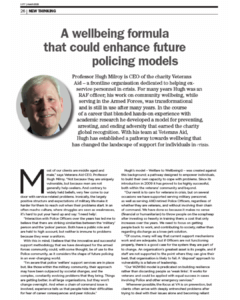
Veterans Aid recently featured in the London Police Pensioner Magazine (LPP).
The article reads:
A Wellbeing Formula That Could Enhance Future Policing Models
Professor Hugh Milroy is CEO of the charity Veterans Aid – a frontline organisation dedicated to helping ex-service personnel in crisis. For many years Hugh was an RAF officer; his work on community wellbeing, while serving in the Armed Forces, was transformational and is still in use after many years. In the course of a career that blended hands-on experience with academic research he developed a model for preventing, arresting, and ending adversity that earned the charity global recognition.
With his team at Veterans Aid, Hugh has established a pathway towards wellbeing that has changed the landscape of support for individuals in crisis. Glyn Strong reports…
Most of our clients are middle aged and male,” says Veterans Aid CEO, Professor Hugh Milroy. “Not because they are uniquely vulnerable, but because men are not generally help-seekers. And contrary to widely held beliefs, very few come to our door with service-related problems. Ironically, the largely positive structure and expectations of military life make it harder for them to reach out when their problems start. In an often-macho culture, where struggles are seen as weaknesses, it’s hard to put your hand up and say: ‘I need help’. “Interaction with Police Officers over the years has led me to believe that there are striking similarities between the ‘military’ person and the ‘police’ person. Both have a public role and are held to high account, but neither is immune to problems because they wear a uniform. With this in mind, I believe that the innovative and successful support methodology that we have developed for the armed forces community could, with some thought, be of use to the Police community, as it considers the shape of future policing in an ever-changing world.”
“I’m aware that police ‘welfare’ support services are in place but, like those within the military community, their approach may have been outpaced by societal changes, and the complex, constantly evolving problems that they bring. Things are getting better, in all large organisations, but they won’t change overnight. And when a chain of command issue is involved, experience tells us that people hide their difficulties for fear of career consequences and peer ridicule.”
Hugh’s model – Welfare to Wellbeing© – was created against this background; a pathway designed to empower individuals, to build their own capacity to cope with problems. Since its introduction in 2009 it has proved to be highly successful, both within the veterans’ community and beyond.
“Our remit is to care for veterans in crisis, but on several occasions we have supported serving military personnel, as well as serving AND retired Police Officers, regardless of whether they are veterans, and without involving their chain of command. We have done so because it makes no sense (financial or humanitarian) to throw people on the scrapheap after investing so heavily in training them; a cost that only increases over the years. We need to focus on getting people back to work, and contributing to society, rather than regarding discharge as a knee-jerk solution. “Of course, many will say that current support mechanisms work and are adequate, but if Officers are not functioning properly, there is a good case for the system they are part of to change.
An organisation’s greatest asset is its people, and if staff are not supported to the point where they can give their best, that organisation is likely to fail.
A ‘disposal’ approach to vulnerability is a failure of leadership. “Our W2WB© model is predicated on building resilience rather than discarding people as ‘weak links’. It works for veterans and could be applied with equal success in cases involving Police and other emergency services.”
Whenever possible, the focus at VA is on prevention, but clients often arrive with deeply entrenched problems after trying to deal with their issues alone and becoming reliant on alcohol or drugs. Add relationship breakdown, loneliness, domestic violence, mental health deterioration and social isolation to the mix and the downward spiral is rapid.
“There is very little that we haven’t seen or dealt with,”says Hugh. “Everyone seeking our help believes that their problems are unique and beyond resolution – but that’s rarely the case. We don’t offer quick fixes, but we do pledge to support clients who will accept help, for as long as it takes. Sometimes a single, swift intervention can resolve a seemingly overwhelming dilemma; in other cases, we have to address multiple issues, which can take considerable time and money.
“The collective expertise of VA’s Operations Team is vast and what we can’t provide in-house, we can outsource to our network of reliable, like-minded professionals who provide everything from counselling to detox. Welfare to Wellbeing© isn’t a ‘one size fits all’ solution; it’s a model that looks at individuals and says What do YOU need? And when we have established that, we support our clients until they are back on their feet and capable of sustainable independent living. Key to this is placing the individual totally centre stage. This is critical when dealing with multi-faceted issues and, to this day, I have never met anyone with just a single problem!”
Veterans Aid’s clients range in age from 17 to 90; some haveserved for a day; others are career soldiers. Some are infantry training failures; others are Senior Officers with decades of service. “There is clear synchronicity with other uniformed services, but unlike organisations that simply exclude those who don’t‘qualify’ for help, we take a wider view,” says Hugh. “Practical compassion and acceptance of a shared humanity underlines everything we do at VA. Some of the calls we get are from spouses, partners, employers and even children reaching out on behalf of someone too proud or ashamed to ask for themselves. Every interaction I have with Police Officers leaves me wishing I had a magic wand to be able to create a ‘Police Services’ version of us.
“As a taxpayer, as a citizen wishing to have effective policing for all, and as the creator of a successful frontline support model that regularly gets problematic people back on a sensible path, I believe that investing rather than rejecting is the right thing to do.
“At Veterans Aid we are focused on what is needed, wherever and whatever that is,” says Hugh. “And we don’t judge.
Life in Britain today is hard; poverty is rife: people make mistakes, get bullied, have breakdowns, get treated unfairly, and do things that they bitterly regret. But when they reach out to VA we look at where they want to be, not where they have been.” Veterans Aid’s unique understanding of how individually the concept of ‘wellbeing’ translates has earned it international acclaim. Nearer home the charity is formally linked to many police services, transport providers, local authorities, and specialist mental/physical health practitioners.
Although operating from just two London locations – Victoria Square HQ/Operations Centre and East London residential facility – it deals with calls from UK veterans from all over the world. Some members of VA’s Ops team have served in the armed forces themselves; all are highly qualified and experienced in their field. The charity’s experts include an addictions specialist and a dedicated Criminal Justice Officer Paul Ellis, who is a veteran and former Police Officer, served with the MPS for 30 years. It was Paul – who has been a volunteer at VA since 2022 – who pointed out the value of highlighting VA’s work in LPP.
He said: “From my perspective, police support for Police Officers, past and present, really needs to be re-imagined. ‘Welfare’, while having its place, has been outpaced on many levels. We need to do more than just identify symptoms which, in truth, have career implications. Sadly, it’s often fear of those implications that holds people back, compounding their problems and denying them the holistic help that could lead to recovery. “Many of those who struggle are conflicted about asking for help because the Job is about so much more than employment; yes, it’s about income and long-term financial security, but it’s also about trust, comradeship, peer perception and career progression. I believe that a more modern, pragmatic and compassionate approach to individuals’ problems is called for and that a police version of the VA model could play a significant role in what is a challenging
future for policing.”


